About
Education2024: Ph.D. in Electrical Engineering, Washington University in St. Louis, Advisor: Prof. Lan Yang2019: B.S. in Physics (Poling Class), Nankai University
WorkExperience2026/09 – Present: Professor, School of Physics, Nankai University2024/04 – 2026/09: Postdoctoral Research Associate, WashU, Advisor: Prof. Lan Yang2017/06 – 2017/09 & 2018/10 – 2019/02: Visiting Student, Harvard U, Advisor: Prof. Marko Lončar
ResumeDr. Wenbo Mao is a Professor in the School of Physics at Nankai University. His research focuses on integrated photonics, non-Hermitian physics, topological photonics, optical sensing, and micro/nanophotonic devices, aiming at developing novel mechanisms and chip-scale integrated photonic platforms.
Research FieldsMy research uses integrated photonic chips as a platform to study light-field control, light-matter interactions, and new physical mechanisms in optical systems. My research interests include integrated photonics, non-Hermitian physics, topological photonics, optical sensing, and laser physics. Our group is recruiting postdoctoral researchers, doctoral students, and master students. Welcome to contact me to explore novel on-chip optical devices and physical mechanisms together!
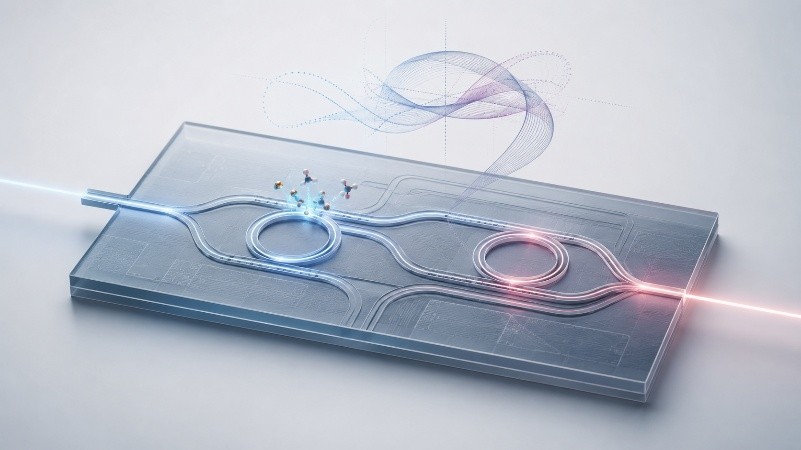
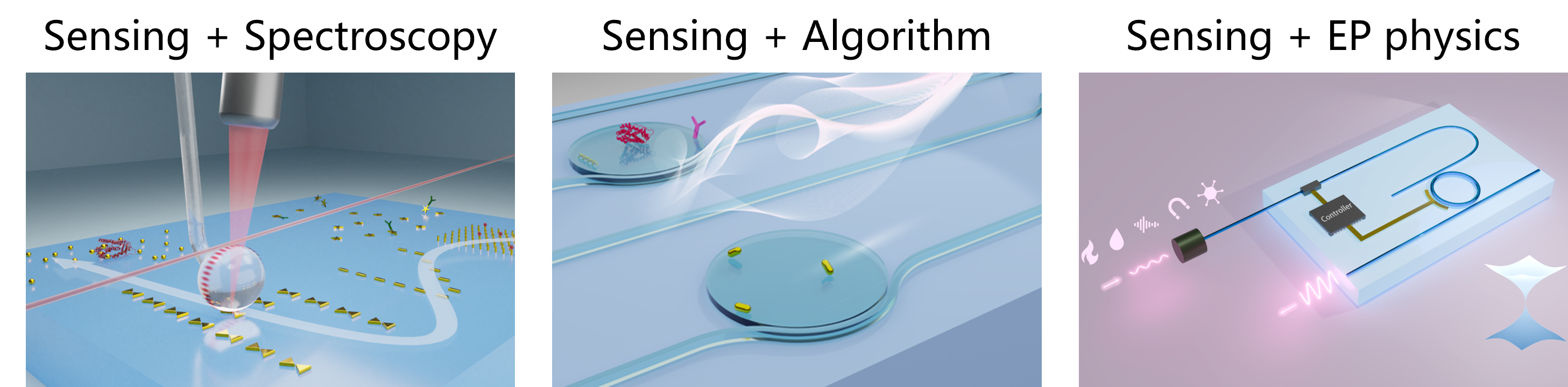
Fig. 1. Conceptual illustration (generated by AI) Integrated photonics is not only a technological route toward miniaturized optical devices and system-level integration, but also an important platform for studying light-field control, light-matter interactions, and physical phenomena in open systems. Compared with conventional free-space or fiber-based systems, photonic chips allow precise engineering of refractive index, loss, gain, coupling, and modulation at the micro- and nanoscale. This capability provides rich opportunities for constructing novel optical Hamiltonians, controlling light propagation and mode evolution, enhancing optical sensing, and investigating laser dynamics. Our group uses integrated photonic devices as a platform to explore new phenomena and mechanisms in non-Hermitian physics, topological photonics, and laser physics, and to develop chip-scale photonic platforms for sensing, light-field control, and integrated light sources. The research mainly includes: 1. On-chip optical sensing A central challenge in on-chip optical sensing is not only to detect weak signals, but also to reliably identify target signals in complex environments. Centered on microcavity-enhanced optical sensing, we combine Raman spectroscopy, nanoplasmonic enhancement, non-Hermitian exceptional-point (EP) enhancement, and multimode spectral-response analysis to develop on-chip sensing technologies with high sensitivity and high specificity. This direction aims to advance on-chip sensors from single-parameter detection toward multidimensional information acquisition and reliable recognition in complex environments, providing new device platforms for molecular detection, biomedical sensing, and environmental monitoring. Representative works include a scanning Raman microprobe combining whispering-gallery-mode (WGM) microcavities with nanoplasmonic structures [Light: Science & Applications, 12, 247 (2023)], a cross-correlation sensing algorithm based on multimode WGMs [Laser & Photonics Reviews, 18, 2301303 (2024)], and a modular EP-enhanced phase sensing platform [Science Advances, 10, eadl5037 (2024)].
Fig. 2. Raman microprobe, multimode sensor, and EP-enhanced sensing module
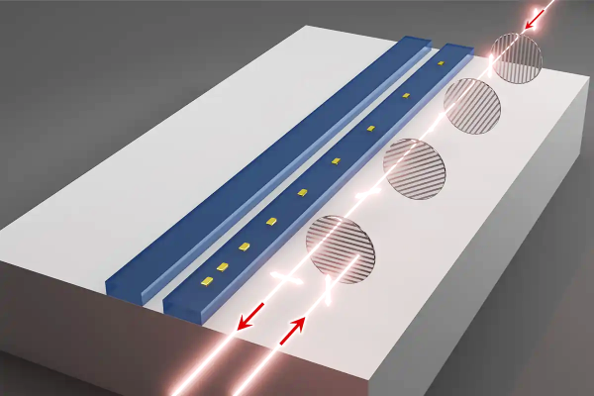
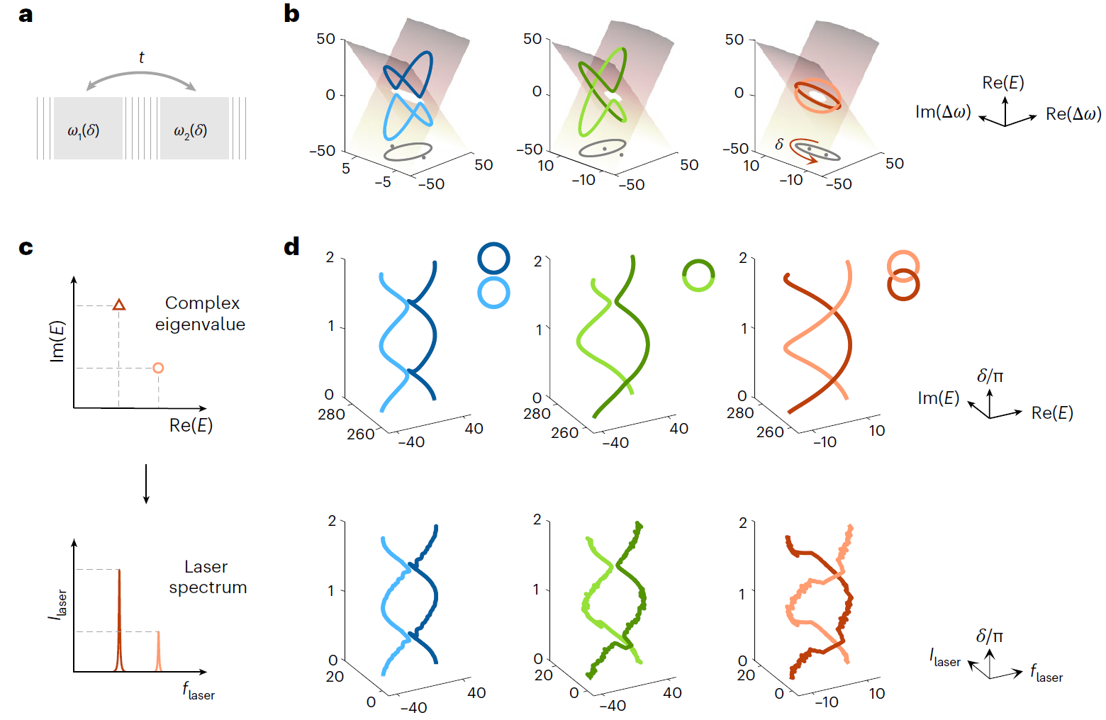
2. On-chip light-field control On-chip light-field control focuses on actively controlling light propagation and mode evolution at the micro- and nanoscale. Compared with conventional photonic devices that rely primarily on fixed structures, non-Hermitian physics and topological photonics provide new degrees of freedom for building tunable, reconfigurable, and programmable photonic devices. This direction aims to translate novel physics mechanisms from fundamental phenomena into on-chip functional devices, providing new routes toward on-chip isolators, reconfigurable optical circuits, and programmable light sources. Representative works include reconfigurable asymmetric transmission in spatially chirped Floquet PT-symmetric photonic waveguides [Science Advances, 11, eadu4653 (2025)], nonreciprocal transmission of microwave acoustic waves based on nonlinear PT-symmetry [Nature Electronics, 3, 267 (2020)], and non-Hermitian braiding of laser modes on a chip, where topological structures such as Hopf links, trefoil knots, and Solomon links were experimentally observed [Nature Physics, 22, 1344 (2026)].
Fig. 3. On-chip spatially chirped Floquet PT waveguides
Fig. 4. On-chip braiding of laser modes
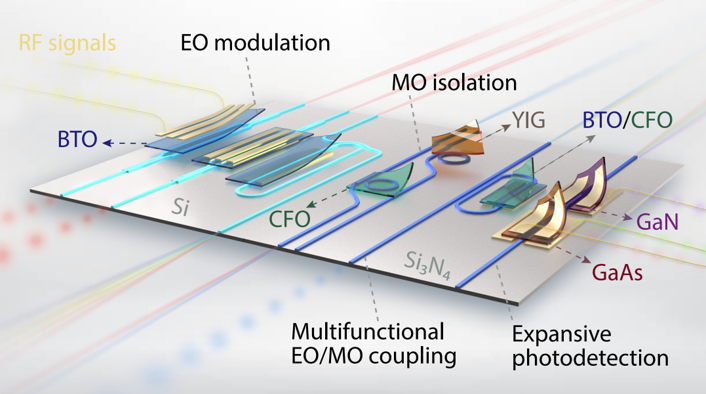
3. Heterogeneous photonic integration A single material platform can hardly meet the demand for multifunctional integration in integrated photonic systems. To address this challenge, we recently collaborated on developing a photonic van der Waals (vdW) heterogeneous integration approach based on single-crystalline functional nanomembranes. This method integrates materials with different crystal structures and functionalities onto silicon and silicon nitride platforms, providing a new material-integration route for building multifunctional on-chip photonic devices. This work uses epitaxial lift-off and two-dimensional-material-assisted layer transfer to prepare and transfer a variety of high-quality single-crystalline functional nanomembranes, including the electro-optic material barium titanate (BTO), the magneto-optic materials cobalt ferrite (CFO) and yttrium iron garnet (YIG), and III-V semiconductors such as gallium arsenide (GaAs) and gallium nitride (GaN). By integrating these functional thin films with prefabricated silicon or silicon nitride photonic chips through vdW integration, we demonstrated efficient electro-optic modulation, on-chip magneto-optic isolation, broadband photodetection from ultraviolet to near-infrared wavelengths, and multifunctional microring devices combining electro-optic and magneto-optic functionalities. This platform overcomes the lattice-matching and process-compatibility constraints of conventional heteroepitaxy, enabling the intrinsic functionalities of different materials to be flexibly incorporated into photonic chips. This work provides an important platform for future integrated light sources, reconfigurable modulators, isolators, detector arrays, and multi-physics photonic devices [Nature, 657, 638 (2026)].
Fig. 5. Heterogeneous integration platform with functional nanofilms AchievementA complete publication list is available on my Google Scholar profile.
Journal Articles †Equal contribution; *Corresponding author. [14] Y. Meng†, W. Mao†, Z. Xu†, D. Jia†, M. Lin, J. Seo, B. Kim, X. Zhang, E. Park, S. Lee, J. Kim, S. Han, J.-Y. Moon, W. Xu, Q. Zhang, X. He, M. Chen, S. H. Nam, J. Hu, J. S. Kim, S. Lee, S. Bae, S. H. Choi, T. H. Kim, Y. Choi, S.-I. Kim, K. Kim, M. Jin, C. Jiang, Y. Zhang, Y.-H. Kim, J.-H. Lee, H. Kim, S. Ran, X. Wang, C.-W. Qiu, F. M. Ross, J. Kim, M. L. Lee, H. Kim, T. J. Kippenberg, L. Yang*, S.-H. Bae*, Heterogeneous photonic integration of single-crystalline nanomembranes, Nature, 657, 638 (2026). [13] W. Mao†, B. Zhu†, Q. Zhang, W. Xu, D. Jia, Y. Meng, C. Wang, F. Li, S.-H. Bae, Q. J. Wang, Y. D. Chong*, L. Yang*, Laser mode braiding on a chip, Nature Physics, 22, 1344 (2026). (News: Braids of light [Link]) [12] W. Mao†, F. Li†, Q. Zhang, W. Xu, K. M. Awan, L. Yang*, On-chip reconfigurable transmission in spatially chirped Floquet parity-time symmetric photonics, Science Advances, 11, eadu4653 (2025). [11] W. Mao†, Z. Fu, Y. Li, F. Li, L. Yang*, Exceptional-point-enhanced phase sensing, Science Advances, 10, eadl5037 (2024). [10] W. Mao†, F. Li†, D. Jia, Q. Zhang, L. Yang*, On-Chip Multimode WGM Microresonator with Cross-Correlation Algorithm for Enhanced Sensing, Laser & Photonics Reviews, 18, 2301303 (2024). [9] W. Mao†, Y. Li†, X. Jiang, Z. Liu, L. Yang*, A whispering-gallery scanning microprobe for Raman spectroscopy and imaging, Light: Science & Applications, 12, 247 (2023). [8] Y. Meng†, J. Feng†, S. Han†, Z. Xu, W. Mao, T. Zhang, J. Kim, I. Roh, Y. Zhao, D.-H. Kim, Y. Yang, J.-W. Lee*, L. Yang*, C.-W. Qiu*, S.-H. Bae*, Photonic van der Waals integration from 2D materials to 3D nanomembranes, Nature Reviews Materials, 8, 498 (2023). (Cover article) [7] C. Wang, Z. Fu, W. Mao, J. Qie, A. D. Stone, L. Yang*, Non-Hermitian optics and photonics: from classical to quantum, Advances in Optics and Photonics, 15, 442 (2023). [6] L. Shao*, W. Mao, S. Maity, N. Sinclair, Y. Hu, L. Yang, M. Lončar*, Non-reciprocal transmission of microwave acoustic waves in nonlinear parity-time symmetric resonators, Nature Electronics, 3, 267 (2020). (News: Directions for non-reciprocal electronics[Link]) [5] Z. Hao, L. Zhang, W. Mao, A. Gao, X. Gao, F. Gao, F. Bo*, G. Zhang, J. Xu, Second-harmonic generation using d33 in periodically poled lithium niobate microdisk resonators, Photonics Research, 8, 311 (2020). [4] J. Lin†, N. Yao†, Z. Hao, J. Zhang, W. Mao, M. Wang, W. Chu, R. Wu, Z. Fang, L. Qiao, W. Fang*, F. Bo*, Y. Cheng*, Broadband quasi-phase-matched harmonic generation in an on-chip monocrystalline lithium niobate microdisk resonator, Physical Review Letters, 122, 173903 (2019). [3] Z. Hao, L. Zhang, A. Gao, W. Mao, X. Lyu, F. Bo*, F. Gao, G. Zhang*, J. Xu*, Periodically poled lithium niobate whispering gallery mode microcavities on a chip, Science China Physics, Mechanics & Astronomy, 61, 114211 (2018). [2] W. Mao, W. Deng, F. Bo*, F. Gao, G. Zhang, J. Xu, Upper Temperature Limit and Multichannel Effects in Spherical Lithium-niobate Optical Parametric Oscillators, Optics Express, 26, 15268 (2018). [1] Z. Hao, J. Wang, S. Ma, W. Mao, F. Bo*, F. Gao, G. Zhang, J. Xu, Sum-frequency generation in on-chip lithium niobate microdisk resonators, Photonics Research, 5, 623 (2017).
Patents [P2] W. Mao, L. Yang, Exceptional-point-enhanced remote phase sensing, US Patent, US20250314507A1. [P1] G. Zhao, J. Liao, Y. Li, W. Mao, Q. Zhang, F. Li, L. Yang, Resonator-enhanced gas sensors, systems, and methods, US Patent, US20250314592A1. Social AppointmentsReviewer for journals including Nature Communications, Light: Science & Applications, Physical Review Letters, Photonics Research, APL Photonics, Advanced Optical Materials, Advanced Photonics Nexus, Communications Physics, Physical Review A, Physical Review B, Applied Physics Letters, Optics Express, and Optics Letters. Teaching ExperienceSpring 2021: Teaching Assistant for ESE 534 - Special Topics in Advanced Electrodynamics: Metamaterials, Washington University in St. Louis Honor TitleThe Challenge Cup, Nankai University, Grand Prize (2019) Poling Scholarship (2016), (2017) China National Scholarship (2016), (2017), (2018) |